Greenwich Property Taxes Explained: The 10.125 Mill Rate, the 2025 Revaluation and What You’ll Actually Pay

Greenwich's mill rate for the fiscal year beginning July 1, 2026 is 10.125, down from 12.041, and it is applied to 70 percent of a home's assessed market value. That works out to about $7,088 a year per $1,000,000 of market value, roughly 37 to 40 percent less than the same house would pay in Darien or New Canaan.
The 2025 revaluation raised the average Greenwich home's value by 28.5 percent, but the mill rate fell to offset it, so a home that moved about the town average saw a modest change rather than a 28.5 percent jump. Your own bill depends on how much your property's value moved relative to that average.
How Connecticut property tax works
Every Connecticut town calculates the bill the same way. The assessor sets a market value, the assessment is 70 percent of that value, and the town applies its mill rate, where one mill is $1 of tax per $1,000 of assessed value:
Annual tax = market value × 70% × mill rate ÷ 1,000.
For a $2,000,000 home at Greenwich's 10.125 mills, that is $2,000,000 × 0.70 × 10.125 ÷ 1,000 = $14,175 a year. Nothing in the formula is negotiable at the closing table: the value comes from the assessor, and the rate comes from the town's budget process.
Greenwich's mill rate: 10.125, and why it fell
The Board of Estimate and Taxation set the general-fund mill rate for the fiscal year beginning July 1, 2026 at 10.125, down from 12.041. The mill rate is the amount the town needs from property taxes divided by the size of the grand list, the total taxable value in town. When the grand list grows, as it did after the revaluation, the same budget requires a lower rate. The town's assessor has said the revaluation is not meant to be a revenue generator, and the lower rate is how that plays out in practice.
The 2025 revaluation: what actually happened
Connecticut requires towns to revalue regularly, and Greenwich's most recent revaluation took effect with the October 1, 2025 grand list. The average residential home rose 28.5 percent in value, and the grand list overall rose about 25 percent, with some revaluation districts rising faster (the town reported increases of 30.6 to 37.7 percent in three of them). The next revaluation is due in October 2030.
A bigger value does not mean a proportionally bigger tax bill, because the mill rate dropped at the same time. Here is the effect on a home that was worth $2,000,000 on the last revaluation, at three levels of value change:
| Change in market value | New market value | Tax at 12.041 mills (old value) | Tax at 10.125 mills (new value) | Change in annual tax |
|---|---|---|---|---|
| 10.0% | $2,200,000 | $16,857 | $15,593 | −7.5% |
| 28.5% | $2,570,000 | $16,857 | $18,215 | +8.1% |
| 37.7% | $2,754,000 | $16,857 | $19,519 | +15.8% |
Illustrative calculation by Greenwich Home Intel: 70% assessment ratio, previous rate of 12.041 applied to a $2,000,000 value and the new rate of 10.125 applied to the revalued amount. Actual bills depend on each property's assessment and any district charges. Value changes shown are the town's reported average residential change (28.5%) and the reported increase in its fastest-rising district (37.7%).
The pattern is straightforward. A home whose value rose about the town average saw a modest increase, a home that rose faster saw a larger one, and a home that rose less than average often saw its bill fall. That is why two neighbors can have different experiences from the same revaluation.
What you would pay on a Greenwich purchase
The table below applies the 2026-27 mill rate to several market values, with Darien and New Canaan for comparison. Use the town's assessment of the actual property for your real number, not the purchase price.
| Market value | Greenwich, per year | Greenwich, per month | Darien, per year | New Canaan, per year |
|---|---|---|---|---|
| $1,000,000 | $7,088 | $591 | $11,235 | $11,877 |
| $2,000,000 | $14,175 | $1,181 | $22,470 | $23,754 |
| $3,000,000 | $21,263 | $1,772 | $33,705 | $35,631 |
| $5,000,000 | $35,438 | $2,953 | $56,175 | $59,384 |
| $10,000,000 | $70,875 | $5,906 | $112,350 | $118,769 |
70% assessment ratio times each town's mill rate for the fiscal year beginning July 1, 2026 (Greenwich 10.125, Darien 16.05, New Canaan 16.967). Excludes sewer or other district charges.
For a buyer comparing Gold Coast towns, this is the structural advantage described in our three-town comparison: the Greenwich address costs more to buy, and part of that premium comes back in a lower annual bill. At higher values the dollar gap widens, which is worth including when you set a monthly budget alongside the mortgage payment in our mortgage rates guide.
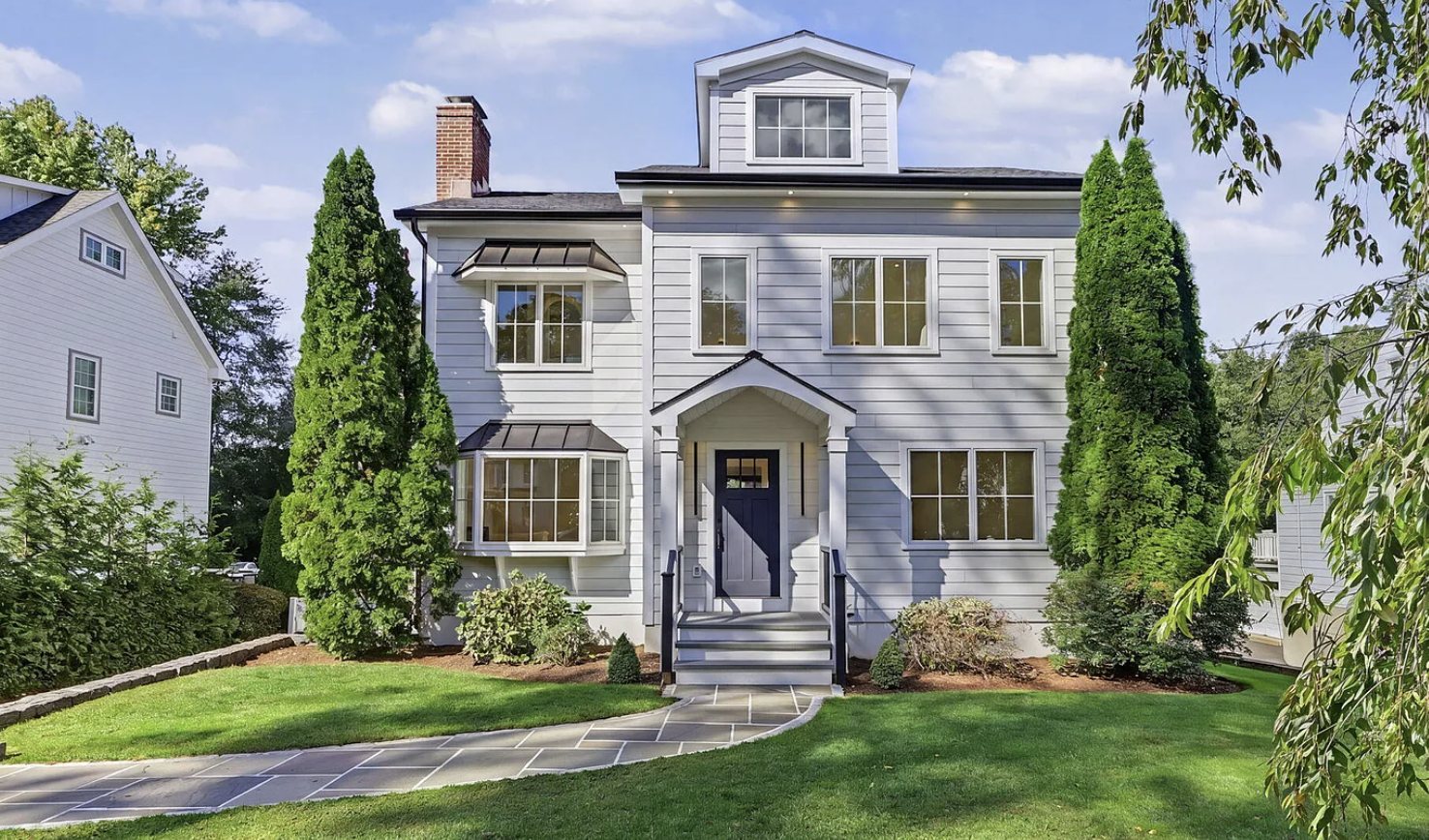
The home pictured above, a five-bedroom, four-bath house asking $2,650,000, is a useful example. If it were assessed at its asking price, the tax at 10.125 mills would be about $18,782 a year, or $1,565 a month. The actual bill depends on the town's assessment of that specific property, which you can look up before you make an offer.
What the general mill rate does not include
The general-fund rate is not the whole picture. Properties in sewer districts pay additional mill rates, so ask which district a house is in. Insurance, utilities and any association fees are separate. A house with a pool, extensive grounds or a newly completed addition may also be assessed higher than a comparable house without them, because the assessor accounts for features such as lot size, square footage, pools, garages, construction quality, bathrooms and fireplaces.
Does buying a house change its tax bill?
Generally, a sale does not by itself change the assessment in Connecticut; the town values property on the revaluation schedule and adds improvements and new construction as they occur. That means the current owner's tax bill is usually a good starting estimate, but confirm with the assessor, particularly if the house was recently renovated or expanded. A Connecticut real estate attorney, who handles your closing, will prorate taxes between buyer and seller.
Appeals and relief
- Appeals. After the 2025 revaluation, the Board of Assessment Appeals accepted appeals from February 1 to February 20, 2026, and about 950 were filed on roughly 20,000 residential parcels. An owner who disagrees with the board can go to Superior Court, which generally must happen within two months of the board's decision being mailed. The next appeal window follows the next revaluation or the annual assessment cycle, so ask the town for current dates.
- Elderly tax relief. The town's application period has run from February 1 to May 15, with an income limit that was reported at $80,000. Check the current rules before you rely on it.
- Veterans exemptions. They exist; ask the assessor for current eligibility.
A buyer's checklist
- Ask for the property's current assessment and tax bill, and confirm which revaluation the assessment reflects.
- Compute the tax at the new mill rate, not the old one, using the formula above.
- Ask whether the property is in a sewer district and what that adds.
- Budget the tax and the mortgage payment together; a lower mill rate helps the monthly total.
- If you plan to renovate or expand, ask the assessor how the improvement would likely be treated.
Peter can walk you through the tax bill on specific homes during a showing, so the number on the listing is the number you actually plan around.
Frequently asked questions
What is the Greenwich CT mill rate?
10.125 mills for the fiscal year beginning July 1, 2026, set by the Board of Estimate and Taxation. The previous rate was 12.041. One mill is $1 of tax per $1,000 of assessed value, and Connecticut assesses homes at 70 percent of market value.
How much are property taxes on a $2 million home in Greenwich?
About $14,175 a year (about $1,181 a month), calculated as $2,000,000 × 0.70 × 10.125 ÷ 1,000. Sewer-district charges and the property's actual assessment can change the real number.
Did property taxes go up after the 2025 Greenwich revaluation?
It depends on the property. The average residential home rose 28.5 percent in value, but the mill rate fell from 12.041 to 10.125, so a home that rose about the average saw a modest increase, a home that rose faster saw a larger one, and a home that rose less often saw its bill fall.
Are Greenwich property taxes lower than Darien or New Canaan?
On the mill rate, yes. For the fiscal year beginning July 1, 2026, Greenwich is 10.125, Darien 16.05 and New Canaan 16.967. At equal market value, the Greenwich bill is roughly 37 to 40 percent lower.
When is the next Greenwich revaluation?
October 2030, according to the town assessor. Connecticut requires regular revaluations, and the town also inspects properties on a rolling basis.
Can I appeal my Greenwich assessment?
Yes. After the 2025 revaluation the Board of Assessment Appeals took appeals from February 1 to 20, 2026, and an owner can go on to Superior Court after the board's decision. Ask the town for current deadlines before you plan an appeal.
- Greenwich Free Press, Greenwich Assessor and BET Chair Explain Ins and Outs of Town Reval: 28.5% average residential change, mill rate from 12.041 to 10.125, appeal window, relief programs and next revaluation.
- Pullman & Comley, 2025 Municipal Revaluations in Connecticut: 70 percent assessment ratio, appeal process, and the list of towns revalued October 1, 2025.
- Greenwich Board of Estimate and Taxation, 2026-27 mill rate of 10.125, set May 18, 2026.
- Town of Greenwich, 2025 Revaluation: the town’s revaluation page.
- Patch, Darien mill rate 2026-2027 (16.05) and NewCanaanite (New Canaan 16.967).
- Tax figures are calculated by Greenwich Home Intel from the cited rates and the 70 percent ratio. Confirm any property’s actual bill with the Town of Greenwich.
Talk it through with Peter.
A short, confidential conversation can turn this framework into a plan for your move.
General information, not legal, tax or financial advice. Figures are cited to the named sources and were checked in October 2026; market data changes, so ask Peter for a current, sourced pull before relying on any number. Consult a Connecticut real estate attorney, your lender and a tax advisor before you act.