What It Costs to Buy a Greenwich CT Home: Down Payment, Closing Costs and the Connecticut Closing Process

Cash to close is your down payment, plus lender, title, attorney and recording costs and prepaid taxes and insurance, minus your deposit. On a $10.95 million purchase with 20 percent down, the down payment alone is $2,190,000.
Connecticut sellers customarily pay the conveyance tax, so it is not on your side of the closing statement. Your lender must give you the Closing Disclosure at least three business days before closing.
A Greenwich buyer who budgets only for the down payment gets surprised at the table. The rest of the cash arrives as a list of smaller items from five different parties, and most of them are priced by someone other than your agent.
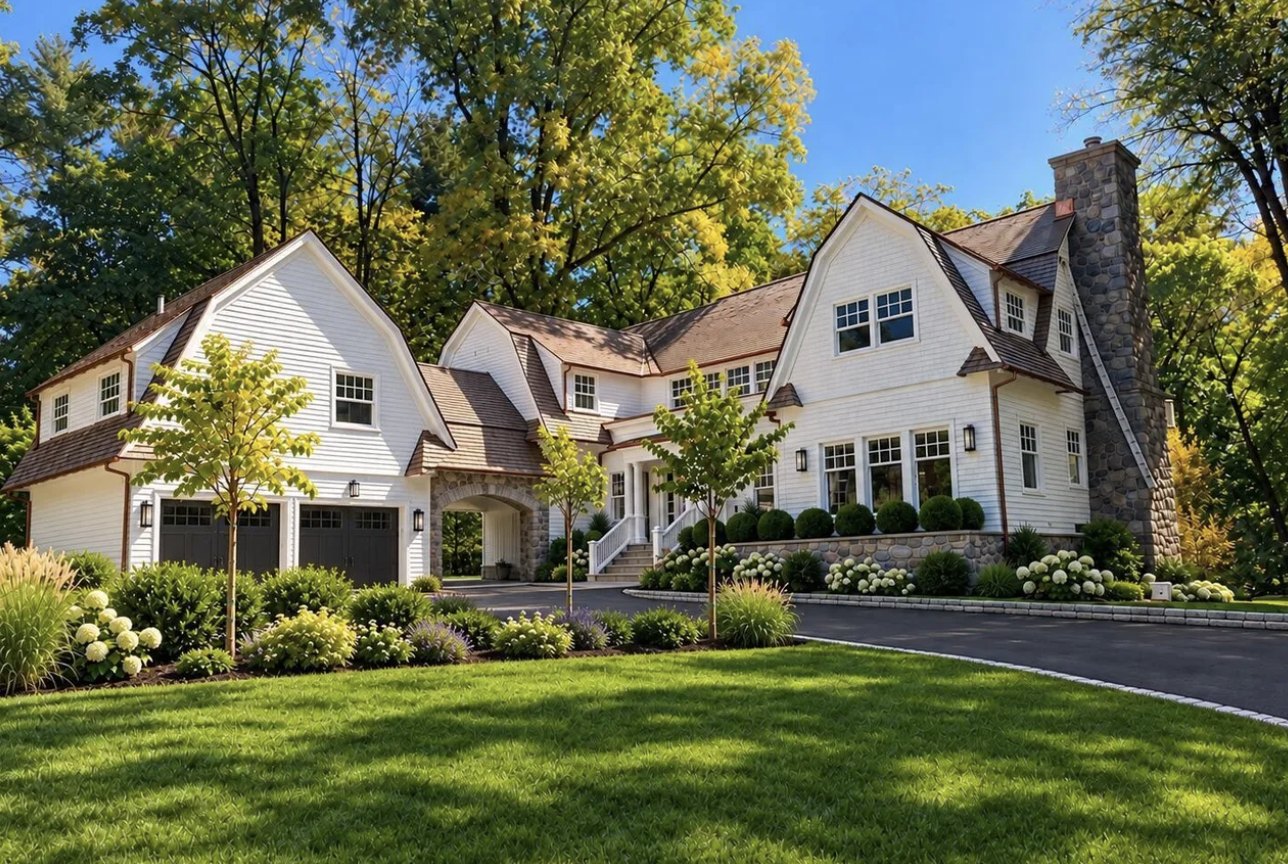
This guide sorts those items by who sets the number and where to find it, gives you the fees the Town Clerk publishes, explains the conveyance tax you do not pay, walks through the closing timeline and gives you an estimator. It uses a $10,950,000 asking price as the example because that is the home in the photo above. It does not invent a closing cost average, because we have no sourced one.
Cash to close has four parts
Cash to close is the check you bring, or wire, after your deposit is credited. Every dollar falls into one of four groups.
| Part | What is in it | Who sets the number |
|---|---|---|
| Down payment | The share of the price you pay in cash. At 20 percent on $10,950,000 it is $2,190,000 and the loan is $8,760,000. | You and your lender. Loans above the conforming limit are jumbo loans, and jumbo lenders can ask for more cash and reserves. Ask early. |
| Lender and third-party fees | Origination and underwriting charges, appraisal, credit report, flood certification and similar services. | Your lender, itemized on the Loan Estimate. Estimates vary widely among lenders. |
| Title, attorney and inspections | Lender’s title policy, optional owner’s title policy, your attorney, home inspection and any septic, radon or oil tank tests. | Title and attorney fees come from the providers you choose. The Loan Estimate shows which services you can shop for. |
| Government fees and prepaids | Town Clerk recording fees, the tax and insurance escrow, prepaid interest and the share of the current tax bill your contract assigns to you. | The Town Clerk for recording, your lender for escrow, the Town Tax Collector for the bill, your contract for the split. |
Source: Consumer Financial Protection Bureau, Shop for title insurance and other closing services (closing costs can add up to thousands of dollars and vary widely among lenders; title services are the largest costs in the shoppable group).
The fees the Town Clerk publishes
Recording is the one line you can price today. Connecticut towns charge the land records fees in Section 7-34a of the General Statutes, and the Greenwich Town Clerk lists them in a fee schedule effective July 2025.
| Document | Greenwich Town Clerk fee |
|---|---|
| Deed (warranty, quitclaim, trustee) | $70 for the first page and $5 for each additional page. Add $2 if money is conveyed. Form OP-236 is required for any deed, with or without conveyance tax money. |
| Mortgage deed | $70 for the first page and $5 for each additional page. |
| Certified copy of a recorded document | $1 per page plus $2 per certification. |
Source: Town of Greenwich Town Clerk, Recording Fee Schedule effective July 2025. Westport’s Town Clerk lists the same $70, $5 and $2 figures under Section 7-34a. Confirm current fees with the Greenwich Town Clerk. Who pays which recording fee is set by your contract and closing statement.
A deed of a few pages and a mortgage of a dozen or more pages put recording well under a thousand dollars. The cost that moves is not recording. It is the price, the loan and the tax bill.
Conveyance tax: the seller files it, and the rate is steep at the top
The Connecticut Department of Revenue Services says a grantor, the grantor’s attorney or the grantor’s authorized agent files Form OP-236, and the return and any tax are due when the deed is recorded. The customary allocation puts the tax on the seller. Your contract controls, so have your attorney confirm it.
You still want to know the number, because it sits inside the seller’s pricing. The Town Clerk lists the rates.
| Slice of the price | State rate | Town rate |
|---|---|---|
| First $800,000 of residential property | 0.75% | 0.25% |
| $800,000 to $2,500,000 | 1.25% | 0.25% |
| Above $2,500,000 | 2.25% | 0.25% |
Source: Connecticut Department of Revenue Services, Real Estate Conveyance Tax Information (filing and payment at recording); Greenwich Town Clerk fee schedule and Conn. Gen. Stat. Section 12-494 as listed by the Westport Town Clerk (rates). Re-verify if the legislature changes them.
On a $10,950,000 sale those rates produce $217,375 in state tax and $27,375 in town tax, a total of $244,750, or about 2.24 percent of the price. That is the seller’s cost, and it is one reason a seller at this level guards the number. Our seller cost guide works the same table from the other side.
Property taxes: two bills a year and no published split
Greenwich bills real estate tax in two installments, due July 1 and the following January 1. To avoid interest, you pay the July bill by August 1 and the January bill by February 1. Late payments carry interest at 1.5 percent a month.
The Town’s tax page does not say how a bill is divided when a home sells. Your contract and closing statement set that, and your lender may also collect an escrow. Ask your attorney how the current bill is handled, and call the Tax Collector at 203-622-7891 with questions about an outstanding bill.
For budgeting, the general mill rate for the fiscal year that began July 1, 2026 is 10.125 mills, and assessed value is 70 percent of the Assessor’s appraised market value. If the Assessor appraised the home at $10,950,000, the general-rate tax would be about $77,608 a year. Properties on the town sewer also pay sewer rates. The Assessor sets the real appraisal, and a new home may be appraised on a different basis than the asking price, so ask the Assessor how a newly built house will be assessed. See Greenwich Property Taxes Explained.
Title insurance: one policy is usually required, one is your choice
The Consumer Financial Protection Bureau says most lenders require a lender’s title insurance policy, which protects the amount they lend. You may want an owner’s policy, which protects your own investment in the home. The total cost is usually lower if the same provider writes both. Your lender must give you a list of providers you can shop, and you may be able to choose one that is not on it if your lender agrees.
We do not publish a Connecticut premium schedule, because we have no sourced one. Ask your attorney for written quotes for both policies before you sign the contract.
The closing timeline
Connecticut closings are customarily handled by attorneys, and buyers retain one early. The sequence below is Greenwich Home Intel’s planning order. Only the Closing Disclosure timing is a federal rule.
| Stage | What happens | Cash it can trigger |
|---|---|---|
| Offer and deposit | You make an offer, agree terms and pay a deposit as the contract provides. | The deposit. It is credited against cash to close. |
| Attorney review and contract | Your attorney reviews the contract, title and any contingencies. | Attorney retainer or fee. |
| Inspections | Home inspection, plus septic, radon, oil tank, pool or shoreline review as applicable. See the inspection guide. | Inspector fees, usually paid when performed. |
| Loan application | Your lender issues the Loan Estimate and you lock or float your rate. | Application and appraisal fees. |
| Appraisal and title search | The lender orders the appraisal and the title search is run. | Appraisal, title search and title policy premiums. |
| Closing Disclosure | The lender must deliver it at least three business days before closing. Compare it to the Loan Estimate. | Final cash to close. |
| Walkthrough and closing | You walk the house, sign, fund the loan and wire cash. The deed and mortgage are recorded. | Cash to close and recording fees. |
Source for timing: Consumer Financial Protection Bureau, When do I get a Closing Disclosure? and What is a Closing Disclosure? The Closing Disclosure is a five-page form with the final loan terms, monthly payment, fees and charges. The remaining rows are a planning sequence, not a legal requirement.
If the home is new construction
New construction adds three checks to the list above.
- Certificate of occupancy. The Town of Greenwich says occupying a building without one violates Section 111.1 of the Connecticut State Building Code, and it issues one only after the field inspections are approved. Confirm it exists before closing. See Teardown, Renovate or Buy Land in Greenwich CT for how the Town counts floor area.
- The builder’s registration. The Connecticut Department of Consumer Protection registers new home construction contractors and administers the New Home Construction Guaranty Fund. An archived Department page describes claims of up to $50,000 for owners who hold a judgment or arbitration award against a registered contractor who cannot pay, with deadlines and steps. Check the current Department page and your attorney’s advice before you rely on it.
- The assessment. A newly finished house may be appraised differently from an older one. Ask the Assessor before you budget the tax bill.
Our new construction page covers what to review in a builder contract.
Cash-to-close estimator
Enter the figures from your Loan Estimate and your attorney’s quotes. The estimator computes the down payment and the Town Clerk recording fees. It leaves every other line at zero until you fill it in, so a low total means missing inputs, not a low cost.
Cash-to-close estimator
The example starts at the $10,950,000 asking price with 20 percent down. Change any field.
Your pre-offer checklist
- Ask your lender for a Loan Estimate on the real price and loan size, and ask whether the loan is a jumbo loan.
- Decide the down payment and keep reserves beyond it. Do not spend to zero at closing.
- Get written quotes for title insurance and your attorney before you sign the contract.
- Ask your attorney who pays conveyance tax and recording under your contract.
- Ask how the current Greenwich tax bill is divided, and whether your lender will escrow taxes.
- Price inspections and tests for the house, including septic, radon and oil tanks where they apply.
- For new construction, confirm the certificate of occupancy, the builder’s registration and the assessment basis.
- When the Closing Disclosure arrives, compare it to the Loan Estimate line by line within the three-day window.
- Wire only to instructions you confirm by phone with your attorney’s office.
Peter can walk your Loan Estimate and contract with you before you offer. Our how to buy, new construction and Greenwich real estate pages cover the market.
Frequently asked questions
How much cash do I need to buy a house in Greenwich CT?
You need the down payment plus closing costs and prepaid items, less the deposit you already paid. On a $10,950,000 purchase with 20 percent down, the down payment alone is $2,190,000. Lender fees, title insurance, your attorney, inspections, the appraisal and the tax and insurance escrow come on top, and only your Loan Estimate and attorney can price them. See Mortgage Rates and Greenwich Prices for the monthly side.
Who pays closing costs when buying a home in Greenwich CT?
Both sides pay some, and your contract decides the rest. Buyers customarily pay the lender’s fees, the appraisal, inspections, title insurance for the loan, their own attorney and recording fees. Sellers customarily pay the real estate commission, their attorney and the conveyance tax. A seller credit can move a cost to the seller, but only if the contract says so. See What It Costs to Sell a Greenwich Home.
Does the buyer pay conveyance tax in Connecticut?
Customarily no. The Department of Revenue Services says the grantor, meaning the seller, or the seller’s attorney files Form OP-236 and the tax is paid when the deed is recorded. Greenwich’s Town Clerk lists the rates: 0.75 percent to $800,000, 1.25 percent to $2.5 million and 2.25 percent above for the state, plus 0.25 percent for the town. Your purchase contract controls who pays, so have your attorney confirm it.
When do I get the Closing Disclosure for a Greenwich CT purchase?
By law, your lender must give you the Closing Disclosure at least three business days before closing. It is a five-page form with the final loan terms, your monthly payment and the fees and charges. Compare it to your Loan Estimate line by line, and ask your lender about any change before closing day, not at the table.
How are Greenwich CT property taxes handled at closing?
Greenwich bills real estate tax in two installments, due July 1 and the following January 1, and interest runs at 1.5 percent a month after August 1 and February 1. The Town does not publish a rule for splitting a bill between buyer and seller, so your contract and closing statement decide it. Ask your attorney how the current bill is handled and call the Tax Collector at 203-622-7891. See Greenwich Property Taxes Explained.
Do I need owner’s title insurance when I buy in Greenwich CT?
The Consumer Financial Protection Bureau says most lenders require a lender’s policy, which protects the amount they lend, and that you may want an owner’s policy to protect your own investment. The total is usually lower if you use the same provider for both. You can often shop for title services, and your Loan Estimate shows which ones. See How to buy in Greenwich.
- Town of Greenwich Town Clerk, Recording Fee Schedule effective July 2025: deed, mortgage and certified copy fees, the $2 added when money is conveyed, Form OP-236 requirement.
- Town of Westport Town Clerk, Land Records: the same $70, $5 and $2 figures under Section 7-34a, and the state and local conveyance tax rates under Section 12-494.
- Connecticut Department of Revenue Services, Real Estate Conveyance Tax Information: the grantor, the grantor’s attorney or agent files Form OP-236; return and tax due at recording.
- Town of Greenwich Tax Collector, FAQ on real estate tax payment: July 1 and January 1 installments, August 1 and February 1 interest dates, 1.5 percent monthly interest, contact number.
- Town of Greenwich Assessor, FAQ on assessed value: assessed value is 70 percent of appraised market value.
- Consumer Financial Protection Bureau, When do I get a Closing Disclosure?: at least three business days before closing.
- Consumer Financial Protection Bureau, What is a Closing Disclosure?: five-page form, comparison to the Loan Estimate.
- Consumer Financial Protection Bureau, What is owner’s title insurance?: lender’s versus owner’s policy, shopping, same-provider savings.
- Consumer Financial Protection Bureau, Shop for title insurance and other closing services: closing costs vary among lenders, services you can shop for, provider list.
- Town of Greenwich, Certificate of Occupancy: Section 111.1 of the State Building Code and issuance after field inspections.
- Connecticut Department of Consumer Protection, New Home Construction Guaranty Fund (archived page): claim limit of $50,000, who may file, deadlines. Check the current page.
- Connecticut Department of Consumer Protection, New Home Construction Information for Consumers (archived page): registration of new home construction contractors.
- The four-part cash-to-close framing, the timeline stages other than the Closing Disclosure, the checklist and the estimator are Greenwich Home Intel’s planning tools. We did not verify: any Connecticut attorney fee, title insurance premium, appraisal or inspection price, jumbo down payment or reserve requirements, escrow cushion rules, how Greenwich splits a tax bill between buyer and seller at closing, typical deposit amounts, how the Assessor treats a newly built house, whether any Connecticut mortgage tax applies, whether the changes to a loan that restart the three-day Closing Disclosure clock apply to your loan, or the current New Home Construction Guaranty Fund terms. Confirm them with your lender and attorney.
Know your cash to close before you offer.
A short, confidential conversation, with your Loan Estimate and the contract in front of us, before you make an offer.
General information, not legal, tax or financial advice. Fees, tax rates, federal disclosure rules and Town procedures were checked against the cited sources in October 2026 and can change; confirm them with your attorney, your lender and the Greenwich Town Clerk and Tax Collector before you rely on them. This guide does not say what any specific closing will cost. Fair housing law prohibits steering, and this guide does not rank or characterize neighborhoods. The photo is for illustration and is not an offer of that property.